
The cooperation between the University of Debrecen and the Slovak University of Agriculture (SUA) in Nitra is on the way to expand by involving new academic fields of study. Apart from their collaboration in agricultural and food sciences, the two institutions are now building closer connections in the fields of engineering and economics, too. The latest agreement between the two sides about, among other things, faculty and student exchanges, joint conferences and research projects was signed on Thursday, July 9.
News
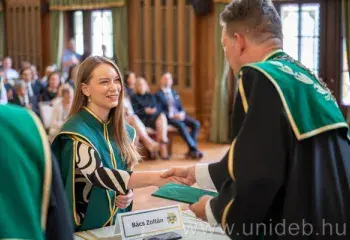
At a ceremony held on Saturday, July 4, in the venue called Aula of its Main Building, the University of Debrecen inaugurated 104 new doctors. Titles for habilitated doctorate and Professor Emeritus status, as well as Excellence Ph.D. Scholarships of the Count István Tisza Foundation for the University of Debrecen were also awarded at the event.
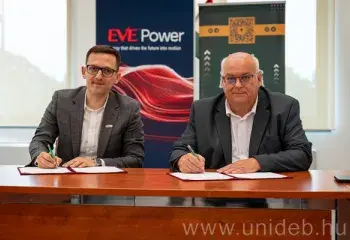
The Faculty of Engineering of the University of Debrecen has concluded an agreement with EVE Power Hungary Kft. on the development of practice-oriented engineering programs, the training of new talent in shortage occupations and the launching of a targeted education program. The agreement was officially signed on Thursday, July 2.

Nicolas Rubio, the agricultural counselor of the United States Department of Agriculture (USDA), gave a talk on the processes of the global agricultural market, the development of economic relations between the European Union and the United States, and the most important trends in EU-US agricultural trade at the Faculty of Agricultural and Food Sciences and Environmental Management of the University of Debrecen. His visit offered yet another opportunity to strengthen educational, research and innovation relations between the University of Debrecen and its partners in the United States.
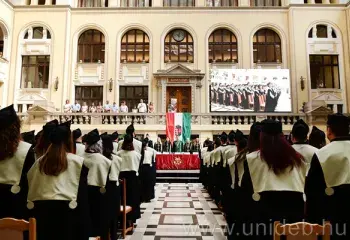
During the spring semester of the 2025/2026 academic year, more than 550 students at the Faculty of Economics of the University of Debrecen fulfilled the requirements for graduation and received their diplomas on Friday in the Ceremonial Courtyard of the university’s Main Building. At the ceremonial faculty meeting, Dean Veronika Fenyves announced that the faculty’s program portfolio will be expanded with a new master’s degree program.
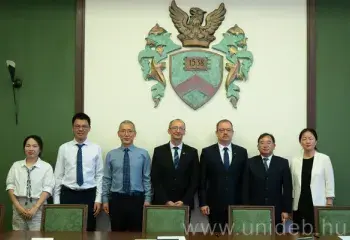
The University of Debrecen has recently signed a cooperation agreement with two Chinese universities in order to establish joint training programs with them. This agreement was signed on Thursday in the presence of the leaders of Beijing Institute of Technology (BIT) and East China University of Technology (ECUT). The joint program projects will hopefully start in 2027.
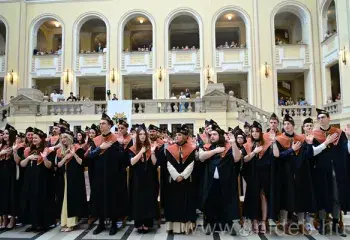
Following the 158-year tradition of agricultural studies in higher education in the city of Debrecen, 185 students from the University of Debrecen’s Faculty of Agricultural and Food Science and Environmental Management received their diplomas on Friday in the Aula of the Main Building. Among the graduates, 116 received diplomas with honors, high honors or distinction.
Students enrolled in the MSc program in Drug Development Research Management at the Faculty of Pharmacy, University of Debrecen, recently participated in a comprehensive training program. Their interactive training began with a theoretical foundation, which was then continued with a practical session at a company based in Dunakeszi that provides, among other things, services in biotechnology and pharmaceutical research as well as analytics.
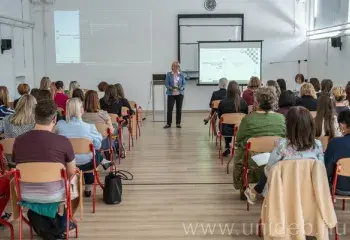
A two-day international conference on the development of the so-called inclusive education projects in secondary schools is held at the Faculty of Education for Children and Special Educational Needs of the University of Debrecen in Hajdúböszörmény. At the event, which is attended by almost eighty participants including the hosts, experts from Slovakia, Poland and the Czech Republic are to share their experiences on this topic.
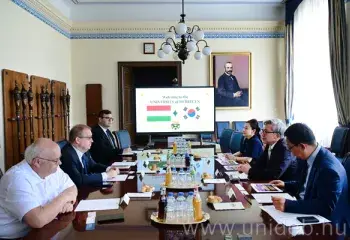
The management of the University of Debrecen received a delegation from Ulsan College, accompanied by H.E. Park Chul-min, Ambassador of the Republic of Korea to Hungary. During the meeting held during the course of the visit, discussions were held, among other things, on preparations for an internship program scheduled for the end of this summer to be supported jointly by Ulsan College, the University of Debrecen and the company EcoPro BM.