
Vitamin C and the Hidden Life of Plants – A Forgotten Pioneer
Today, vitamin C is widely known as an essential nutrient for human health. It supports the immune system and plays a key role in protecting our cells from oxidative stress. But nearly a century ago, a Hungarian scientist asked a much less obvious question: what role does vitamin C play in the life of plants?
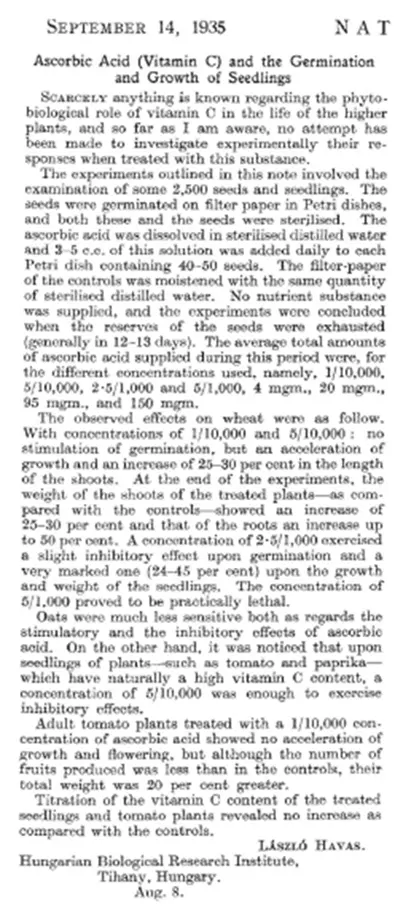
In 1935, László Havas published pioneering work in Nature examining the effects of ascorbic acid on plant germination and growth. At the time, very little was known about the biochemical processes underlying plant development, and his research opened a new direction in plant physiology. His experiments demonstrated that vitamin C is not merely present in plants, but actively influences their growth processes.
Later observations revealed that its effects are highly dependent on concentration. In certain conditions, ascorbic acid can stimulate growth, while in others it may inhibit it. This dual role highlighted an important principle: small molecular changes can have significant impacts on plant development. These early findings helped lay the groundwork for understanding plant metabolism, stress responses, and the role of antioxidants in biological systems.
Today, these questions remain highly relevant. Research into plant biochemistry, nutrient enrichment, and functional compounds continues to build on the same foundations — exploring how internal chemical signals shape plant growth and quality. László Havas’s work is a reminder that some of the most important scientific ideas begin with simple, fundamental questions. His legacy continues to resonate in modern plant science, even if it is not always widely recognized.
Explore the origins of this research:
Havas L. (1935) — Ascorbic Acid (Vitamin C) and the Germination and Growth of Seedlings, Nature
Havas L. (1935) — Effect of Vitamin C (Ascorbic Acid) on the Growth of Plants, Nature
Havas L. & Gál I. (1936) — Divergent Physiological Effects of Synthetic and Natural Ascorbic Acids, Nature
The life and scientific legacy of László Havas were presented at the III. Hungarian Plant Breeding Memorial Day and Conference (NEK 2024) titled “Knowledge of the past and tasks of the future – Polyploidy in plant breeding”.
Further materials in Hungarian are available on the conference website:
https://konferencia.unideb.hu/hu/NEK2024

László Jenő Havas (1885- 1951)
Modified Gravity – Early Hungarian Space Plants Experiments
Long before plants were grown on the International Space Station, scientists were already asking a fundamental question: how do plants behave when gravity is no longer constant?
In the 1960s, Hungarian researchers András Garay and Ferenc Sági were among those exploring this question through controlled experiments on Earth. Their work focused on how altered or reduced gravity affects plant growth, development, and structure — a topic that would later become central to space biology.
One of the earliest studies (Garay et al., 1965) investigated the growth of white-flowered lupin and oat under modified gravitational conditions. These experiments revealed that gravity is not just a passive environmental factor, but a key regulator of plant form. Root orientation, shoot direction, and overall development were all strongly influenced by changes in gravitational forces.
Nearly two decades later, Sági and colleagues (1984) continued this line of research by examining durum wheat under constant gravitational stress. Their work showed that reduced gravity conditions can significantly affect plant growth dynamics, development patterns, and even yield components. These findings highlighted how sensitive plants are to their physical environment, and how deeply gravity is embedded in their biological processes.
At the time, these experiments were not directly connected to space missions. Yet today, their relevance is unmistakable. Understanding how plants respond to altered gravity is essential for growing food beyond Earth, where the familiar conditions of our planet no longer apply.
These early Hungarian studies represent more than isolated experiments — they are part of the scientific foundation of space plant research. They demonstrate how questions explored decades ago under laboratory conditions have become central to one of the most ambitious challenges of our time: sustaining life in space.
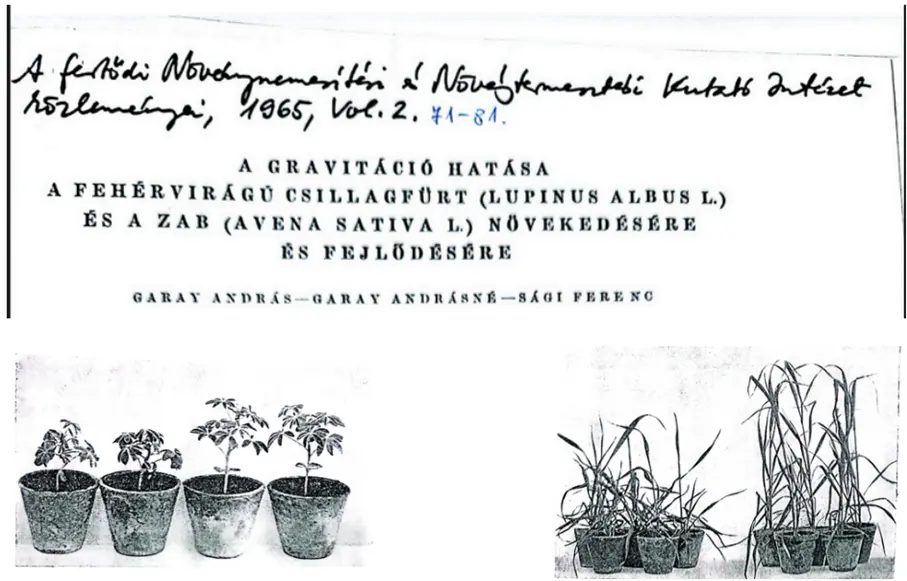
Garay A., Garay A.-né, Sági F. (1965) — Effect of Gravity on the Growth and Development of White-flowered Lupin (Lupinus albus L.) and Oat (Avena sativa L.)
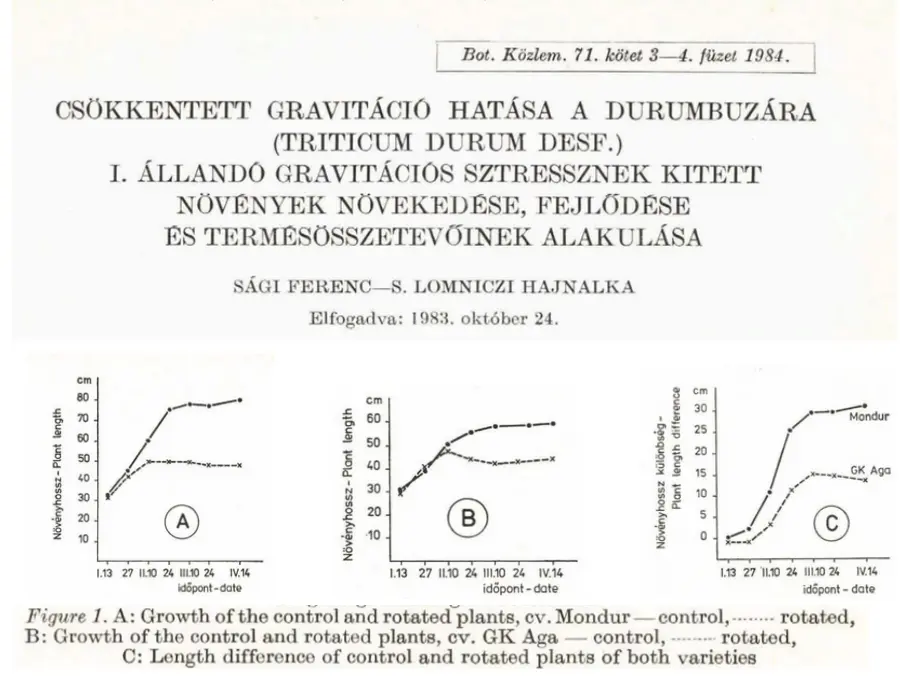
Sági F., Lomniczi H. S. (1984) — Effect of Reduced Gravity on Durum Wheat (Triticum durum Desf.) – Growth, Development and Changes in Yield Components of Plants Exposed to Constant Gravitational Stress
From Vision to Reality – Károly Ereky and the Birth of Biotechnology
More than a century ago, a Hungarian engineer, economist, and visionary thinker introduced a word that would later define an entire scientific field: biotechnology. In 1919, Károly Ereky published his book “Biotechnologie der Fleisch-, Fett- und Milcherzeugung im landwirtschaftlichen Grossbetriebe”, in which he described a new way of thinking about production — one where biological processes could be harnessed and optimized at an industrial scale.
At the time, Ereky was addressing a very practical problem: how to produce enough food to sustain a growing population. His answer was both simple and revolutionary — instead of relying solely on traditional agriculture, biological systems themselves could be engineered, controlled, and scaled. In doing so, he effectively laid the conceptual foundation of what we now call biotechnology.
Ereky was not only a scientist, but also a politician, minister, engineer, and innovator, with numerous patents and interdisciplinary contributions to his name. His work reflected a rare combination of technical expertise and systems thinking. He saw agriculture not as a set of isolated processes, but as an integrated system where biology, technology, and economics meet.
Today, biotechnology is everywhere — from medicine and food production to environmental protection. It allows us to design crops with improved nutritional value, develop sustainable protein sources, and create controlled cultivation systems. Many of the challenges Ereky identified — especially the question of how to produce sufficient, high-quality protein — remain central issues even today.
In the context of space exploration, these ideas gain an entirely new dimension. When we think about producing food beyond Earth, we are essentially applying biotechnology in its purest form: designing closed, efficient systems where biological processes are carefully managed to sustain human life. In this sense, Ereky’s vision is no longer theoretical — it is becoming a practical necessity.
What began as an early 20th-century concept has evolved into one of the most important scientific frameworks of the 21st century. Ereky’s work reminds us that the future of life support systems — whether on Earth or in space — is deeply rooted in the intelligent use of biology.
Hungarian books about Ereky’s life and work:
Fári M. G., Kralovánszky U. P., Popp J. (2015) — Biotechnológia anno 1917–1919, Ereky Károly víziója az élettudomány alkalmazásáról
Fári M. G., Popp J. (2016) — Biotechnológia anno 1920–1938 és ma, Ereky Károly programja a fehérjeprobléma megoldásáról és napjaink feladatai
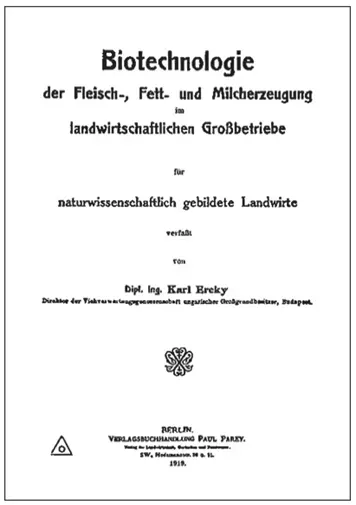
Károly Ereky (1878-1952)