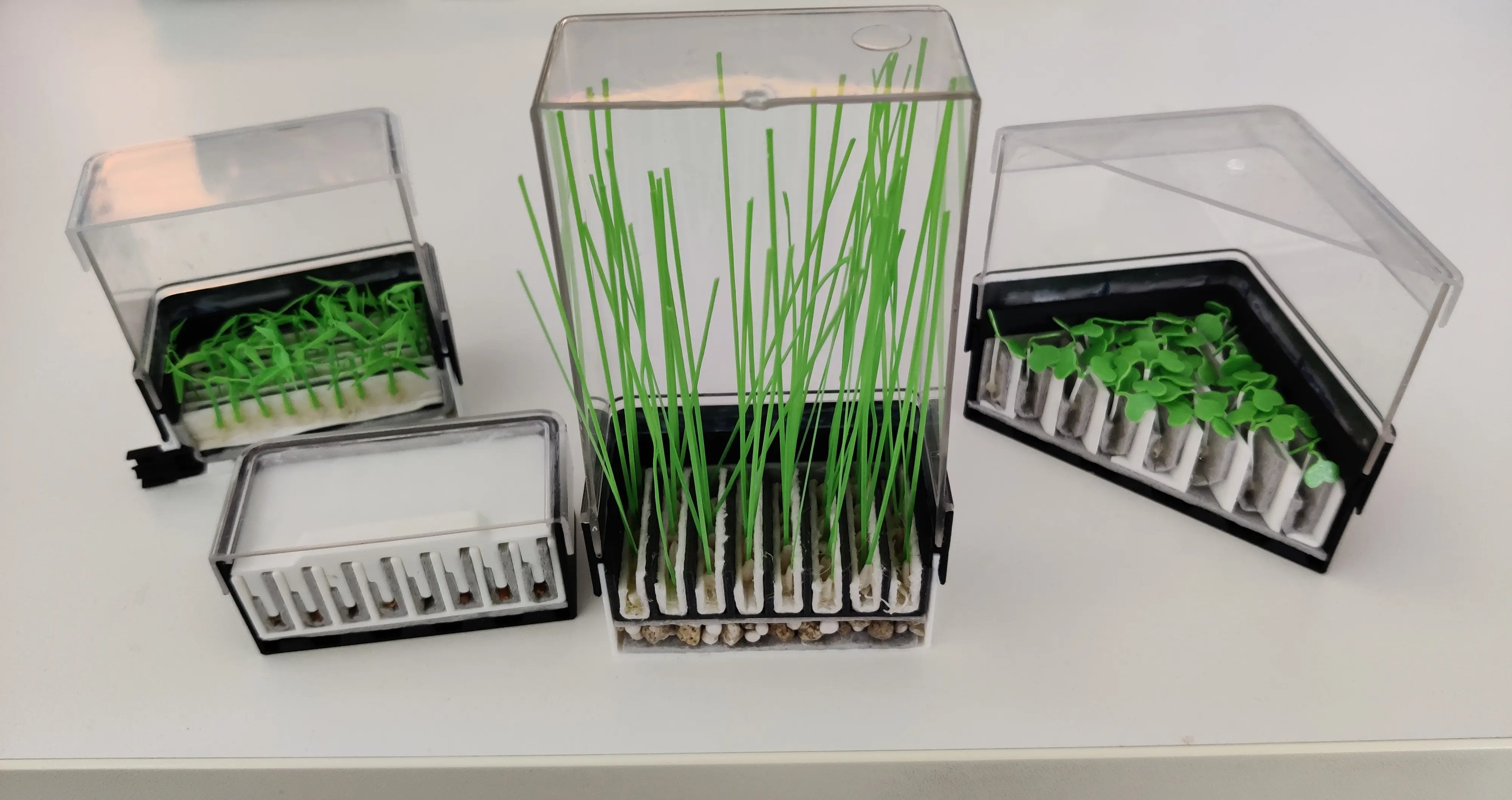
The developed plant cultivation device is an innovative, modular system that enables the germination of plant seeds and the cultivation of plants not only under conventional terrestrial conditions, but also in microgravity environments and in clinostat-based experiments. The key feature of the system is that it operates entirely on a passive water and nutrient supply principle, eliminating the need for pumps or any active fluid circulation systems. This represents a significant advantage in terms of both energy efficiency and operational reliability .
The entire device was manufactured using 3D printing technology at the University of Pécs. The use of digital fabrication enabled rapid prototyping, precise fitting of individual components, and straightforward further development and customization of the system.

The system is built around a non-transparent germination container equipped with an integrated fluid inlet through which water or nutrient solution can be introduced. At the bottom of the container, a high-absorption wicking layer is placed, which plays a central role in the operation: it absorbs the liquid via capillary action and distributes it evenly throughout the system. On top of this layer, a replaceable germination module is positioned, providing a controlled environment for seed placement and germination.
The modular design allows the device to be adapted to different applications. In one configuration, a comb-like germination unit is used, featuring parallel slots into which absorbent strips are inserted. Seeds are placed between the layers of these strips, which are in direct contact with the wicking layer, ensuring continuous water and nutrient supply. In another configuration, the system utilizes individual seed-holding elements, where seeds are placed separately and connected to the water supply through absorbent strips.
Depending on the growth stage, different cover systems can be applied. During the initial germination phase, a light-blocking cover provides a dark environment, while in later stages a transparent cover with ventilation openings supports photosynthesis and proper gas exchange. In certain configurations, a sliding cutting plate can also be integrated, enabling simple and clean harvesting of microgreens.
The system can be further extended with an additional chamber that can be filled with a soilless growth medium, such as zeolite, lava rock, pumice, foam glass beads, or slow-release nutrient granules. This configuration enables sustained plant development under controlled conditions.

During operation, water introduced into the container is transported through the wicking layer to the seeds, and then continuously supplied to the root zone via the absorbent strips. This passive mechanism ensures adequate water, air, and nutrient supply without any need for active intervention, which is particularly advantageous in microgravity environments .
During development, three different device types were created. The VSG (Vitapric Seed Germinating) unit was used for pepper seed germination, the VMG (Vitapric Microgreen Growing) unit was applied for radish microgreen production, and the VPG (Vitapric Plant Growing) unit was used for wheat cultivation experiments. These configurations clearly demonstrate the versatility of the system and its applicability across different growth stages.
One of the main advantages of the developed device lies in its versatility: the same system can be used for seed germination, microgreen production, and plant cultivation. In addition, its energy-efficient operation, simple design, and modular structure significantly reduce operational and logistical costs. Based on these features, the device is suitable not only for research purposes but also for food production applications, especially in specialized environments such as space stations or controlled-environment agriculture systems.
The figure below shows a 3D-printed cross-sectional view of the device, illustrating the arrangement of the main structural components and the compact design of the system.